
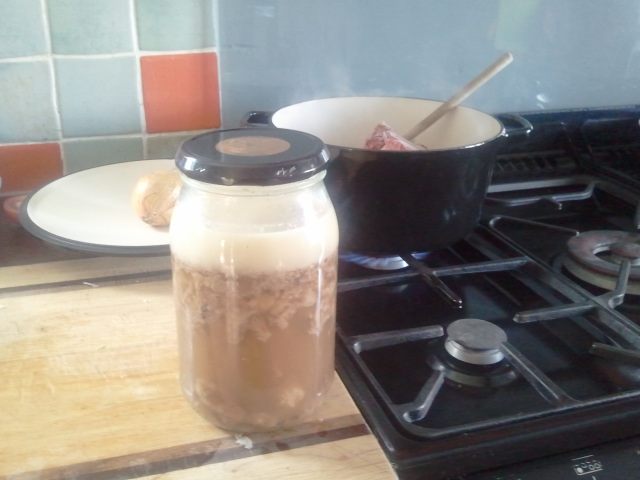
Along with chicken and Lamb stock, Beef Bone Stock is a staple of UnPCKitchen cooking.
Whether wanting to start the day with a warming and soothing drink or just needing a pick-up or a warming, nourishing drink, this is a must! And, of course, essential for casseroles and stews.
Keep life simple.
Here, I roasted a few bones and an ox tail for about 40 mins. I don’t think that this is essential, however, the ox tail was frozen and I needed to cut it into smaller pieces…

After roasting..
I put the bones into a large stainless steel pot, added water, a few tablespoons of cyder vinegar, 1 tablespoon of salt and about 6 bay leaves:

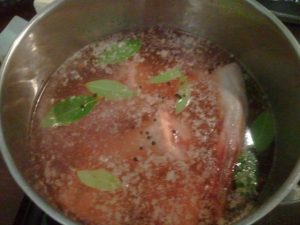
Look at the marrow in this bone:

Leave the bones to gently simmer for at least eight hours. If you cannot complete the stock, you can alwasy re-heat, bring to the boil and leave to simmer for a few more hours. You can simmer for several days.
Here you can see the essential and oh so valuable cooked bone marrow:
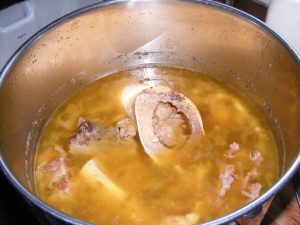
When the stock is cool enough to handle (and it can take a few hours to cool down) remove the bones and knock the marrow back into the stock …..

Shaking out the valuable, nutritious bone marrow, which is rich in vital fats and vitamin D
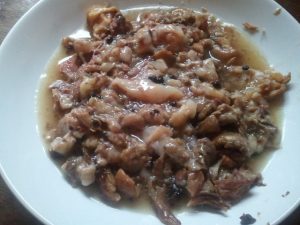
This is everything I could scrape from outside and inside the bone
Normally I scrape everything back into the pot, but you can chop up into smaller pieces or liquidise to blend in with the stock.
SAMSUNG
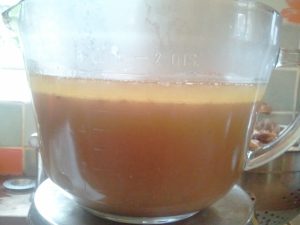
Here you can see the fat beginning to separate and rise to the top of the stock.
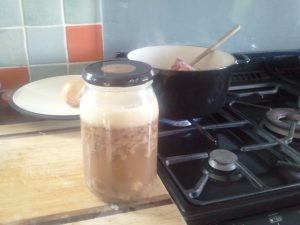
Cooled down and just look at that wonderful layer of fat 🙂
Possibly the easiest way pf preserving your stock is to freeze in smaller quantities. Another way is to sterilise glass jars and their metal lids, keeping them as hot as possible, and with the stock having been bought back to the boil, pour it into the jars, and screw the lids on tightly. Remember to use a cloth or silicon heat protector when screwing on the caps. After a while you should hear the lid “pop” and see that the centre is depressed, indicating an airtight, sterile seal.